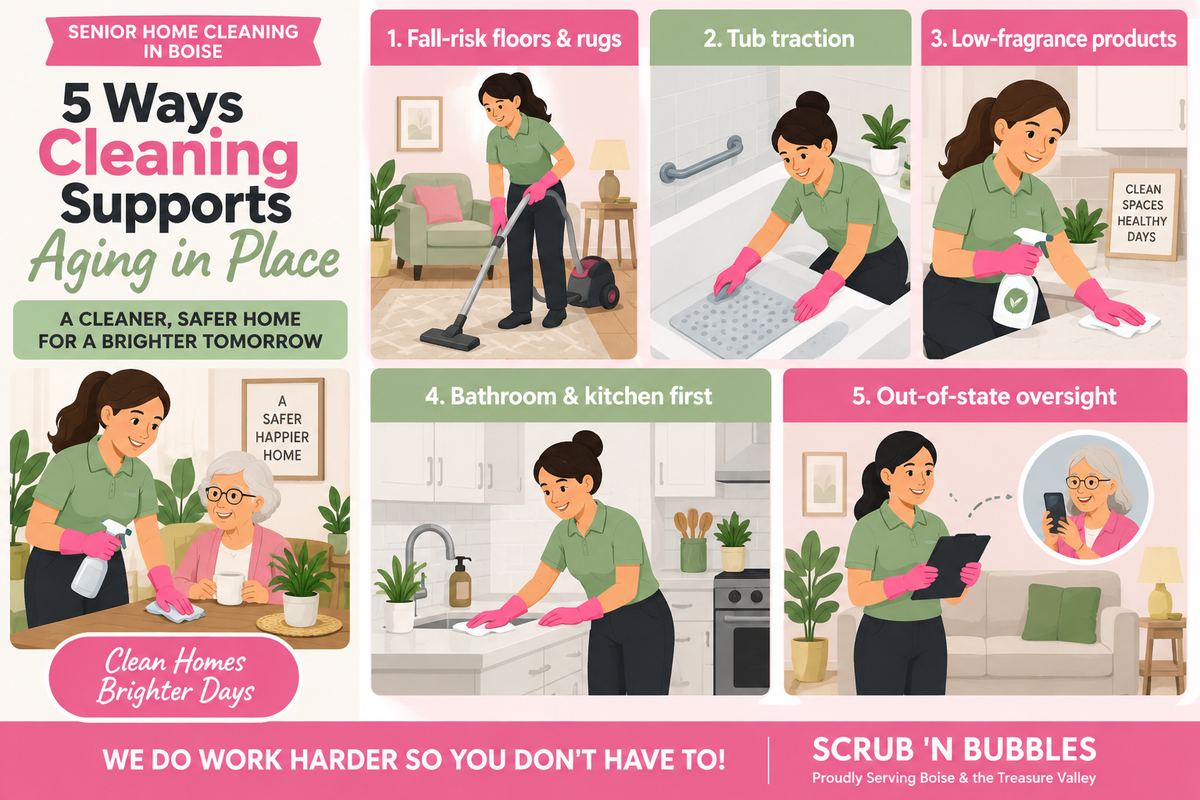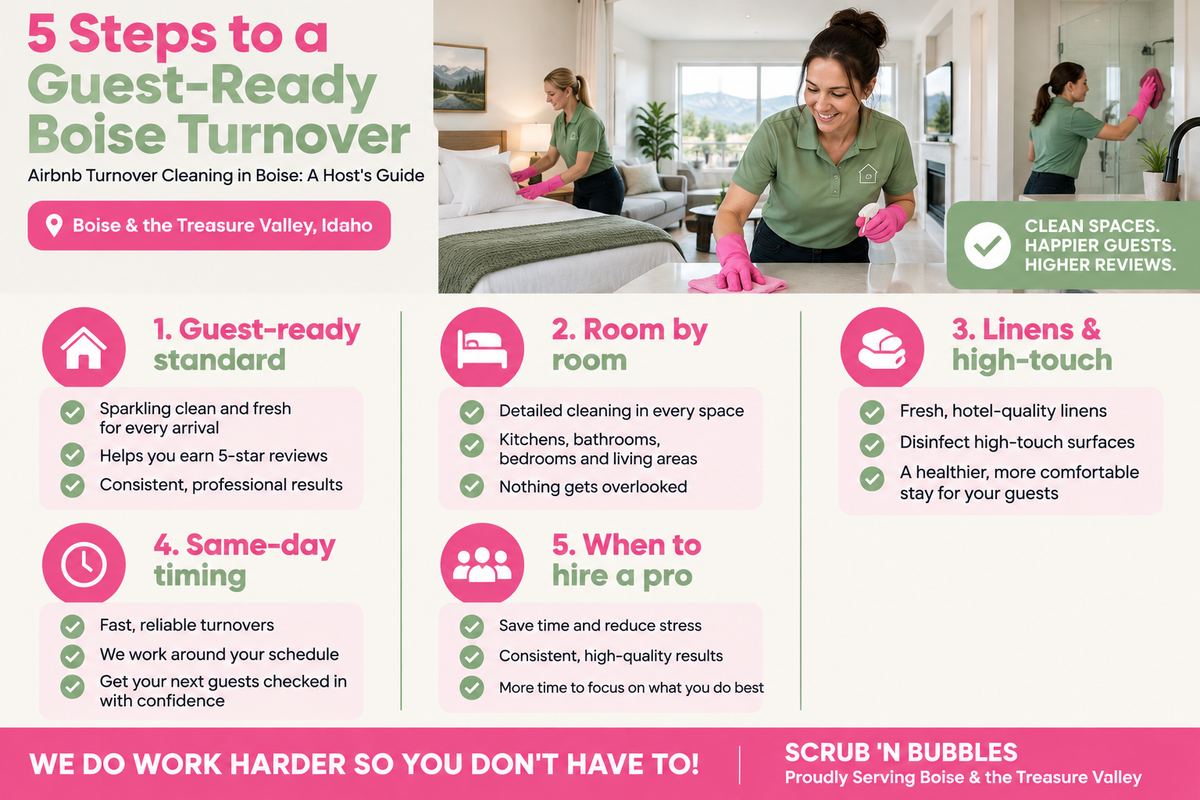
The most common question we hear from Treasure Valley homeowners isn’t about price. It’s about scope: “What exactly happens when your team is in my house for three hours?” Almost every disappointing cleaning experience — with any company — traces back to a mismatch between what a homeowner pictured and what the visit was built to cover. So here’s a plain look at what a recurring house cleaning includes in a Boise-area home, what sits outside that scope as an add-on, and how to compare quotes without getting fooled by the lowest number.
What “recurring” actually means in your home
A recurring clean — weekly, every other week, or monthly — is maintenance. Its whole job is to hold your home at a steady baseline so grime never gets a running start. That’s a different mission than a one-time reset, where the goal is clawing back months of buildup. Maintenance visits are timed, routed, and priced around a home that’s already close to its baseline.
That’s why a first visit usually takes longer than visits three and four. Once the accumulated layer is gone, keeping up is genuinely faster — and we say that up front rather than surprising anyone later.
The standard room-by-room scope
Kitchen: counters and backsplash wiped, exterior of appliances (fridge front, oven front, dishwasher panel), stovetop and control knobs, microwave inside and out, sink and faucet, cabinet fronts spot-cleaned around handles, table and chairs, trash emptied, floor vacuumed and mopped.
Bathrooms: tub and shower walls, glass or curtain track, toilet inside and out including the base and behind, sink, counter, mirror, chrome polished, towel bars, light switches, floor cleaned including behind the toilet.
Bedrooms and living areas: dusting of reachable flat surfaces, nightstands, dressers, shelves, picture frames, lamps and lampshades, window sills and ledges, ceiling fans where safely reachable, beds made (or linens changed if you leave them out), mirrors, floors vacuumed, hard floors mopped.
Throughout: stairs, hallways, door frames and handles, switch plates, visible cobwebs in corners, and a general straighten-up so the home reads as calm rather than just clean.
Notice what that list is built around: the surfaces you touch, see, and breathe near every day.
What our teams actually find in Treasure Valley homes
After more than a decade here, our teams can nearly predict a home’s dirt profile from its zip code and build year.
In the newer subdivisions off Ten Mile and Linder in Meridian, and out through Kuna and Star where construction is still going, the number one recurring issue is fine construction and field dust. It rides in on shoes and through the HVAC while nearby lots are still being graded, and it settles in a predictable order: window sills first, then the top edge of baseboards, then the tops of door casings, then the tracks of sliding patio doors. Homeowners usually notice it on dark LVP or laminate as a hazy film that reappears two days after mopping. That’s not a failed mop — that’s a house next to bare ground in a high-desert valley.
In older Boise homes — the North End, the Bench, parts of Southeast Boise — the pattern flips. Less field dust, more accumulated kitchen and fabric dust: greasy film on the tops of upper cabinets and range hoods, baseboard-heater fins, and the gap between the stove and counter. And during canal and irrigation season, when valley lawns get flood-irrigated and the Ridenbaugh and New York laterals are running, we track more grit and cut grass into entryways than at any other time of year, plus mineral spotting on fixtures from hard Treasure Valley water.
The other thing that surprises people: the order a professional works in is the opposite of how most of us clean at home. Homeowners clean whatever spot looks worst. Our teams go top to bottom, dry to wet, one direction around a room, so gravity works for us — dust knocked off a ceiling fan lands on a surface not yet wiped, then a floor not yet vacuumed. Bathroom product goes on first and dwells while another task happens, because contact time, not harder scrubbing, does the work. That sequencing is most of the reason a two-person team covers a 2,400-square-foot house in the time one motivated person does a kitchen and a bath.
Why smoke and inversion season changes the dust story
Boise’s air does two things to indoor surfaces that homeowners elsewhere don’t deal with the same way. Late-summer wildfire smoke pushes fine particulate into the valley, and winter temperature inversions trap it near the ground for days; Idaho DEQ tracks both through its statewide air quality monitoring program. During those stretches most of us close the house up and run recirculated air — exactly when indoor pollutants concentrate. EPA’s guidance on improving indoor air quality notes that indoor levels of many pollutants can run well above outdoor levels, and that source control and filtration matter far more than air fresheners ever will.
Practically, during smoke season the highest-value surfaces are the ones holding settled particulate: hard floors, window sills, fan blades, upholstery, bedding, and the return-air grille and filter. Damp microfiber and vacuuming — not dry dusting — keep that material from going airborne again.
It also means being thoughtful about product. Scented cleaners and plug-ins add volatile organic compounds indoors; EPA’s overview of VOCs and indoor air quality is worth five minutes if anyone in your home has asthma. We default to low-odor, pet-safe products and ventilate while we work. If smoke is a real health concern in your household, EPA also publishes a free wildfire smoke and health course for the public.
What is normally an add-on — and why
Add-ons aren’t a way to nickel-and-dime you. They exist because they take real extra time, and folding them silently into every visit would either blow the schedule or raise everyone’s price. The usual list:
- Inside the oven. Carbonized spills need dwell time and rack removal. Budget 30–60 minutes.
- Inside the refrigerator. Requires emptying, and someone has to make the keep-or-toss food decisions — that’s your call, not ours.
- Interior windows and glass doors. Standard visits cover mirrors and glass spot-cleaning; full panes, frames, and tracks are their own job. Exterior windows are a separate trade.
- Full baseboard and trim wipe-down. Standard visits catch visible dust on reachable baseboards; hand-wiping every linear foot of a 3,000-square-foot home is an hour or more on the floor.
- Inside cabinets, drawers, and the pantry. Emptying and re-shelving is the time cost, not the wiping.
- Garage, patio, deck, and unfinished basement. Different dirt, different equipment, and in Idaho, frequently a wasp situation.
- Interiors of the washer and dryer, laundry folding, dishes, vaulted-ceiling fans, blinds, upholstery, and inside light fixtures.
- Wall washing and hand-scrubbing grout. Legitimate work, just not maintenance work.
A sensible approach with any company is to rotate add-ons rather than buy them all at once: oven one month, interior glass the next, baseboards after that. You get a whole-house reset spread across a year, for less cost and less disruption.
What is genuinely out of scope for any cleaning company
Honesty about limits is part of scope clarity. Cleaning teams should not handle biohazard or sewage cleanup, mold remediation beyond ordinary surface soap scum, pest work, appliance or HVAC repair, or anything needing a tall ladder. We also can’t clean what we can’t reach: a counter buried in mail gets dusted around, not excavated. Ten minutes of clearing flat surfaces before a visit buys you real cleaning time.
When DIY is plenty — and when hiring out makes sense
Plenty of Treasure Valley households don’t need a cleaning service, and we’d rather say so. Smaller home, workable weekly rhythm, no pets or allergy issues, a routine that doesn’t eat your weekend? Keep doing what you’re doing. Two habits — wiping wet surfaces the day you use them, and vacuuming entry paths twice a week during irrigation and smoke season — prevent most of what we get called about.
Hiring makes sense when the math or the health picture changes: a multi-story home over roughly 2,500 square feet, two working adults with young kids, shedding pets on carpet, someone with asthma or a dust-mite allergy, a mobility limitation that makes tubs and floors unsafe, a rental turnover deadline, or a season of life — new baby, surgery, caregiving, moving — when the cleaning simply is not going to happen. That’s also the point where consistency beats intensity: a steady recurring service nearly always outperforms occasional heroic weekends.
How to compare quotes honestly
The lowest quote is usually the narrowest one. Before you compare numbers, get these six answers from every company you’re considering:
- Is the price for a set scope or a set time block? Both models are fine, but they aren’t comparable. A “three-hour visit” and a “whole-house checklist” can differ by an hour of labor.
- How many cleaners, and for how long? Two techs for two hours is four labor hours. Price per labor hour is the only apples-to-apples figure.
- What’s on the standard checklist, literally? Ask for the list. If a company won’t share one, that’s your answer.
- Is the first visit priced differently? An honest company charges more for the initial catch-up and says so. A suspiciously cheap first visit can mean a thin clean or a steep jump later.
- Insured, bonded, background-checked, employees or contractors? This decides who’s liable if something breaks and who is walking through your home.
- What’s the fix-it policy? Everyone misses something eventually. What matters is whether they come back.
And for your side of the ledger: tell the company your top three priorities. Almost every homeowner has them — the shower glass, the kitchen floor, the dog’s corner of the family room. A team that knows your three will get them right every single visit, and that’s what makes a service feel worth the money.
Getting the scope right for your home
If you’d like a plain, itemized picture of what a recurring visit would cover in your home, we’re happy to walk through it — whether you’re in Boise, Meridian, Kuna, or anywhere else in the valley. You can check availability and get a quote on our booking page, and if what you really need first is a one-time catch-up instead of maintenance, just say so — we’ll tell you honestly which one your home is asking for.
Share this article
Related Posts






Follow us
A quick overview of the topics covered in this article.