One of the most common calls we get at Scrub ‘N Bubbles isn’t from the person who lives in the house. It’s from a daughter in Seattle who just spent a long weekend in Boise with Mom, noticed the tub was slick and the fridge had a science experiment in it, and flew home uneasy. She’s fine. She just can’t reach the shower ceiling anymore, and she’s not going to say so.
Helping a parent stay in their own home is one of the quietest, most practical things regular cleaning can do. Not “senior care” — just a clean, safe, uncluttered house that doesn’t create hazards. After more than a decade cleaning homes from the North End to Kuna, we’ve learned that aging in place has a physical maintenance side, and that side is very learnable. Here’s what matters in a Treasure Valley home, what a family can handle themselves, and where hiring help is the honest answer.
Why the Treasure Valley is a great place to age in place — and where it gets tricky
Boise keeps drawing retirees: single-level living is common, winters are mild compared to the Midwest, and the older streets near Camel’s Back Park are walkable enough to stay independent without a car for every errand. The Greenbelt is a gift for anyone who wants daily movement on flat ground.
The tricky part is our climate. High-desert summers bake fine silty dust off farm fields, canal banks, and the half-built subdivisions spreading across Meridian, Kuna, and Star, and it rides inside on shoes and through swamp coolers. Late summer brings wildfire smoke that can push valley air into unhealthy ranges for days at a stretch — you can watch it happen on the Idaho DEQ air monitoring network.Winter inversions then trap woodsmoke and exhaust in the valley bowl for weeks. For an older adult with COPD, asthma, or a heart condition, indoor air quality stops being an abstraction. And much of the valley’s well water is hard enough to leave mineral film on tub floors, which is a traction problem long before it’s a cosmetic one.
Fall-risk reduction is mostly a cleaning job
Falls are the leading cause of injury for adults over 65, and the majority happen at home doing ordinary things. The National Institute on Aging’s room-by-room fall prevention guidance reads almost exactly like a cleaning walkthrough, because most of the fixes are about what’s on the floor and how the floor is finished.
Floors and finishes
Skip the wax. Well-meaning families buy a shine-restoring polish for Mom’s hardwood or LVP and create a slick surface, especially in socks. We use a damp — not wet — microfiber flat mop with a neutral cleaner and let floors dry fully before anyone walks through. On tile the hazard is the opposite: grout haze and soap residue build a film that feels grabby dry and slippery wet. That gets scrubbed, not glossed.
Rugs, cords, and the path from bed to bathroom
Throw rugs are the most common hazard we see, and the hardest conversation to have. A curled corner in a hallway is a tripwire. When a client wants to keep a favorite rug we suggest a non-slip pad instead of pushing to remove it — and we always set it back exactly flat, corners down, never nudged into an angle by the vacuum.
We also watch the nighttime route from bedroom to bathroom, because that’s the trip that goes wrong at 2 a.m. Phone chargers, oxygen tubing, lamp cords, and CPAP lines get routed along baseboards and out of the walking lane, never under a rug.
Tub and shower traction
Here’s the Idaho-specific piece. Hard well water plus body wash leaves a slick mineral-and-soap film on tub floors that a weekly wipe never removes, and it builds so gradually nobody notices the surface changing underfoot. We scrub tub floors and the textured strips with a non-abrasive acidic cleaner, rinse thoroughly — residue is slippery too — then check that suction mats and grab-bar mounts are still genuinely stuck. A grab bar someone leans on is not decorative.
What our teams actually find in a longtime Treasure Valley home
On a first deep clean in a home someone has lived in for twenty or thirty years, the pattern is remarkably consistent — and it’s rarely about neglect. It’s about reach and stamina.
Everything above shoulder height is behind: tops of upper cabinets, range hood filters, shower ceiling corners, fan blades furred with valley dust, door casings. Everything below knee height is behind too: baseboards, toilet bases, under the bed. The middle band — counters, table, sink, front of the fridge — is often spotless, because that’s what a person can still reach and clean daily.
The other consistent find: the laundry room and garage entry. In homes off Chinden or out toward Star, where irrigation season kicks up dust from March through October, the mudroom floor and washer lid carry a gritty film that migrates through the house. We clean that transition zone early rather than last, so we aren’t tracking it back over finished floors. That’s the order our teams work in — top down, dry before wet, dirty transition zones before living spaces, bathrooms and kitchen floors last — and a family member can follow the same order on a Saturday.
And one honest surprise for adult children: the smell they worry about is usually not dirt. Nine times out of ten it’s an old sponge, the disposal, a rarely-run guest bathroom drain, or the refrigerator drip tray — all ten-minute fixes, not evidence that something has gone wrong.
Low-fragrance, low-irritant products matter more after 65
Many households equate “heavily scented” with “clean.” For an older adult that’s backwards. Air fresheners and strong all-purpose sprays release volatile organic compounds, and the EPA notes that VOC concentrations indoors routinely run several times higher than outdoors, with symptoms ranging from eye and airway irritation to headaches. Stack that on a smoky August week or a January inversion and a sensitive respiratory system has nowhere to go.
What we recommend and use in homes with older residents:
- Fragrance-free or lightly scented cleaners rather than perfumed sprays, and no plug-ins or aerosol fresheners at all. The Asthma and Allergy Foundation of America’s healthy home guidance is blunt about scented products as a trigger.
- Never mix bleach with ammonia or acidic cleaners. This is the most dangerous mistake in home cleaning, and it happens most often when someone is trying to attack a tough toilet or shower stain with whatever is under the sink.
- Microfiber and water for most dusting. Mechanical capture beats chemistry for dust, and it adds nothing to the air. Dry dusting with a feather duster just relocates it.
- Third-party-verified products where you want disinfection without harsh residue — EPA’s Safer Choice list is a reasonable shortcut when label reading gets overwhelming.
- Ventilate while cleaning — but check the air first. On a smoke day, keep windows closed and run the bath fan and a HEPA purifier instead.
The rooms that matter most: bathroom and kitchen
If time or budget is limited, put it here. For an older adult, bathroom and kitchen hygiene carry more real risk than a dusty guest room ever will.
Bathroom
Beyond tub traction, the priorities are the toilet base and the wall behind it, the shower’s grout and caulk, and the fan. Chronically damp bathrooms — especially in older Boise bungalows with one small window and no exhaust fan — grow mold, and EPA’s mold guidance is clear that controlling moisture, not just cleaning the visible spots, is the actual fix. If caulk has gone black and spongy, cleaning won’t save it; it needs to be replaced. We flag that instead of scrubbing it forever.
Kitchen
Immune resilience declines with age, so food-contact surfaces deserve real attention: the fridge interior including door shelves and produce drawers, the sink and drain area, cutting boards, the can opener blade, sponges and towels, and the microwave handle.
Working respectfully in a senior’s home
This part has nothing to do with technique, and it’s what earns a long relationship. A house someone has lived in for thirty-five years is a biography; moving a framed photo two inches is not a neutral act.
What we’ve learned, often the hard way: put everything back in the same spot and the same orientation. Ask before discarding anything, even obvious trash. Don’t reorganize a cabinet to be more efficient. Keep the same team on the same house whenever scheduling allows — a familiar face turns a stranger in your home into Tuesday. And keep walkways clear as you work; a vacuum cord across a doorway while you step out to the van is exactly the hazard you came to prevent.
We also keep the client in charge. If the person who lives there still wants to do her own kitchen counters, that’s not a gap to fill — it’s dignity, and we work around it.
How adult children out of state arrange and oversee recurring cleaning
A good share of our recurring clients are booked and paid for by a family member in another time zone. The arrangements that hold up share a few traits.
- Bring the parent into the decision early. A service that arrives as a surprise rarely lasts. “Help with the heavy stuff so you can keep living here” lands very differently than “you can’t manage anymore.”
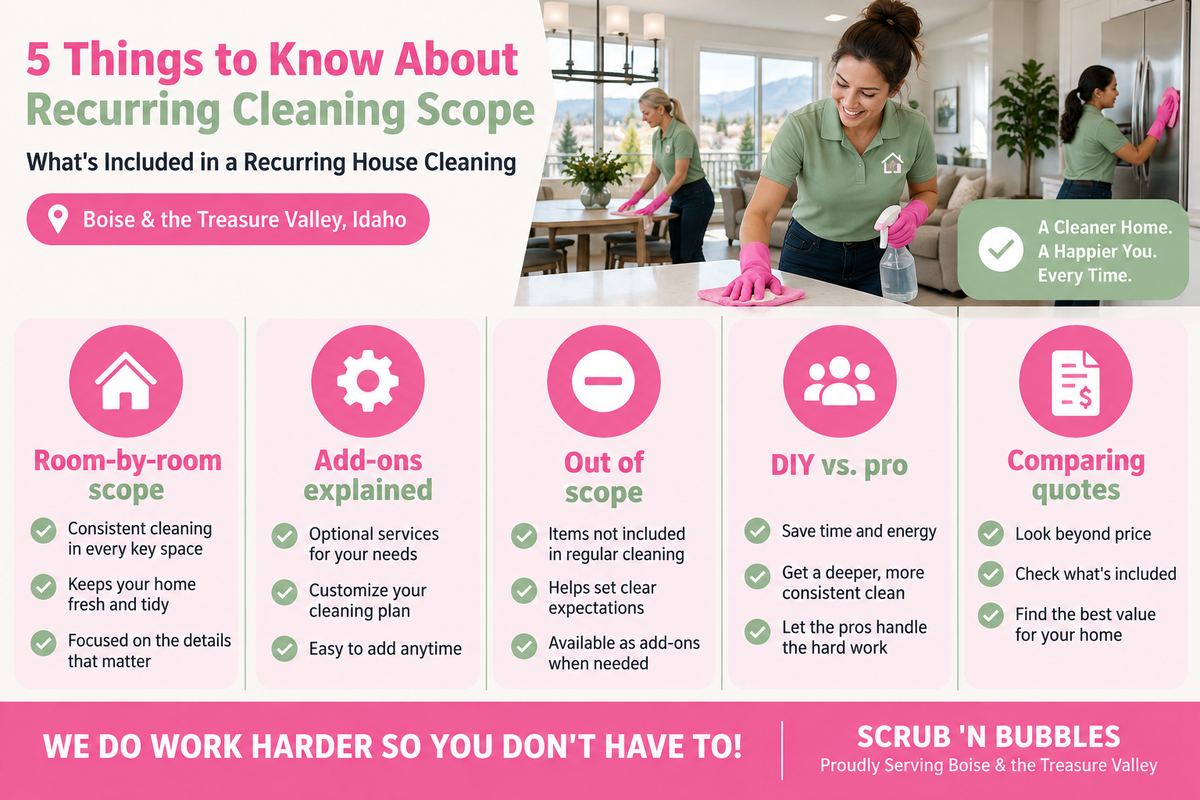
- Start with one deep clean, then go recurring. The first visit resets years of out-of-reach buildup; maintenance visits after that are shorter and calmer. Our top-to-bottom deep clean is built for that reset.
- Every two weeks is the sweet spot for most one- or two-person households. Weekly can feel intrusive; monthly lets bathrooms and floors drift back into hazard territory.
- Write down the specifics. Fragrance sensitivities, which rugs stay, where the spare key or lockbox is, whether the dog needs to be shut in, which room is off limits, and who to call if no one answers the door.
- Insist on insured, background-checked, consistent teams. Non-negotiable when the client is vulnerable and you’re 700 miles away.
When DIY is genuinely enough — and when it isn’t
We’d rather be straight with you than sell you something. Plenty of families handle this themselves for years, and they should.
DIY is enough when: someone nearby can do a monthly reach-and-climb pass (fans, cabinet tops, shower ceiling, under the bed) while the parent keeps up daily surfaces; the bathroom has working ventilation; and there’s no mobility change, recent fall, or new diagnosis. A decluttering afternoon, non-slip rug pads, better bulbs, and a fresh filter beat hiring anyone.
Consider hiring help when: nobody local can do the overhead and floor-level work; there’s been a fall or near-fall; kneeling, ladders, or tub scrubbing are no longer realistic; a caregiver spouse is stretched thin; a respiratory condition makes smoke season genuinely risky; or you’re managing from out of state and need eyes in the house on a schedule. That last one comes up constantly in our Meridian and Eagle neighborhoods, where a lot of retirees moved in near grown kids who have since taken jobs elsewhere.
One boundary worth naming: we are not caregivers. No personal care, medication help, or transportation. If those needs are appearing, your local Area Agency on Aging is the right next call. We handle the house so others can focus on the person.
If a decluttering afternoon, non-slip rug pads, brighter bulbs, and a scrubbed tub floor make the house feel safe again, wonderful — that may be all this ever needs to be. If you work through it and realize the overhead work, the tub, and the every-other-week rhythm aren’t going to happen on their own, that’s what we’re here for. You can see what’s included on our cleaning services page, or get a quote and pick a time whenever you’re ready. We’re happy to talk it through with both you and your parent on the phone first — most of our best long-term relationships started exactly that way.
Share this article
Related Posts

Follow us
A quick overview of the topics covered in this article.